FY 2027 Budget · Findings note · 13 October 2026
Foreign-Assisted Projects and Unprogrammed Appropriations, 2024–2027
How Congress cuts foreign-assisted projects (FAPs) from the programmed budget to make room for insertions, and how Unprogrammed Appropriations (UA) have served as their fallback. Findings note, 13 October 2026.
Summary
- The mechanism. FAPs are proposed high in the NEP and cut in the House bill or the enacted budget. The room freed under the deficit ceiling goes to congressional insertions. The cut projects can then be funded from Unprogrammed Appropriations, released on the strength of the project's existing loan, without any excess revenue. No new loan agreement is needed, but every release adds borrowing on top of the programmed deficit.
- 2024 is the clearest case. DOTr's FAPs were cut from ₱161.34B in the NEP to ₱3.50B in the GAA, a ₱158.41B cut. Thirteen of the 14 cut projects, worth ₱157.91B, are named in the GAA's Unprogrammed Appropriations list. The FAP-related Unprogrammed Appropriations rose from ₱117.73B proposed to ₱233.49B enacted. [1][2][3][4]
- In 2024 Congress also rewrote the release rules. It added text ranking "Support to Foreign-Assisted Projects" first among purposes "not requiring excess/new revenue collections." It also added condition (d), "fund balance of the Government-Owned or -Controlled Corporations (GOCCs)." [1][2]
- In 2025 the route was used. Of ₱218.19B released from Unprogrammed Appropriations in 2025, ₱120.81B (55%) went to FAPs: DPWH ₱58.85B and DOTr ₱40.53B. That year Congress had cut DOTr's programmed FAPs by ₱101.94B. [5][9]
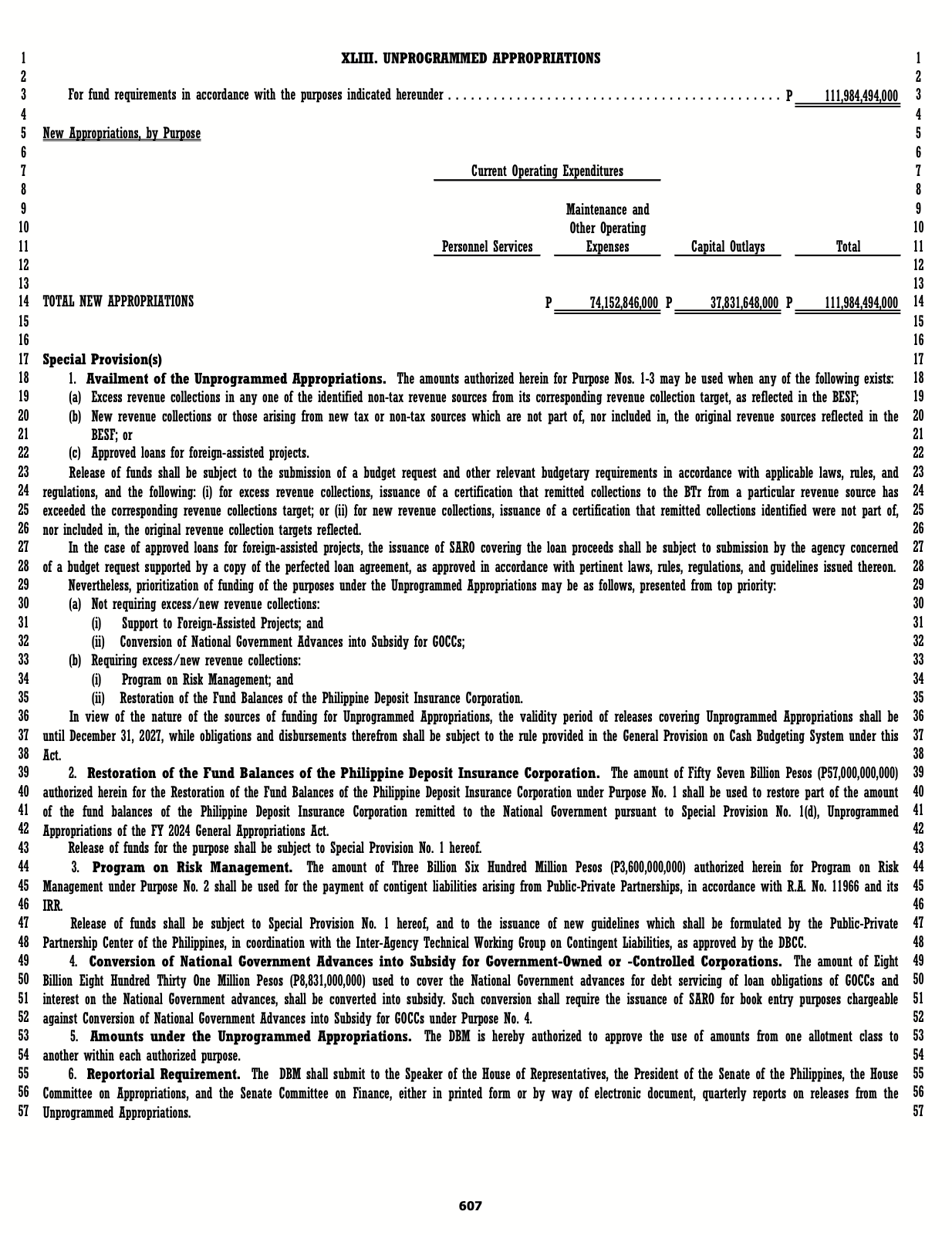
- 2027 so far (House bill). FAPs are cut by ₱130.70B, but Unprogrammed Appropriations are unchanged from the NEP at ₱111.98B. Of that, ₱42.55B is "Support to Foreign-Assisted Projects," and there is no GOP-counterpart purpose. The 2024 priority text is now in the Executive's own NEP. Nothing stops the ₱42.55B from funding the projects the House cut, but it can cover at most about a third. [5][6][7][8]
- The effect on the deficit. The technique never lowers the deficit. If the cut projects are funded from Unprogrammed Appropriations, the actual deficit rises above the program. If they are not, it stays about level only when the projects could have spent the money; otherwise it rises. See section 5a.
- The Senate version and the bicameral report have not been seen yet. In both 2024 and 2025, the jump in Unprogrammed Appropriations appeared in the enacted budget, not the NEP.
1. The mechanism
- Cut FAP lines from the programmed budget. Total new appropriations stay at the NEP level, so the deficit ceiling looks intact on paper.
- Fill the freed room with insertions. These are General Fund items, financed by revenue and general borrowing. The cut loan proceeds cannot pay for them: they are tied to their projects.
- Fund the cut projects from Unprogrammed Appropriations, under condition (c), "approved loans for foreign-assisted projects." The only document required is "a copy of the perfected loan agreement." Since 2024 the text has ranked this purpose as not needing excess revenue.
- The result. The insertions are funded inside the ceiling, and the FAPs are funded outside it by drawing their own loans. Actual spending and the actual deficit end up above the program by roughly the amount released.
- If the projects are not released, they stall, their loans sit undrawn, and costs rise. The insertions have still taken their place.
The GOP-counterpart share is different: Unprogrammed Appropriations treat it as "requiring excess/new revenue collections." So the counterpart portion of a cut has no easy way back.
2. 2024: the template
DOTr's FAPs, NEP against GAA
The NEP proposed ₱161,340,128,000 for 15 DOTr FAPs. The project lines add up to that printed total exactly. The GAA kept only MRT-3 Rehabilitation (₱2.93B). It added one project the NEP did not carry: the New Cebu International Container Port (₱0.57B, GOP counterpart only). The DOTr FAP total in the GAA is ₱3,501,299,000. [3][4]
| Project cut from the programmed budget | NEP 2024 | Loan proceeds | GOP counterpart | In the GAA's UA list? (Special Provision 5) |
|---|---|---|---|---|
| North–South Commuter Railway | 76.34B | 23.09B | 53.26B | yes, (ix) |
| Metro Manila Subway, Phase I | 68.37B | 46.69B | 21.68B | yes, (xii) |
| LRT-1 Cavite Extension | 4.66B | 3.88B | 0.78B | yes, (xxxii) |
| PNR South Long Haul | 3.08B | 1.02B | 2.06B | yes, (xiii) |
| New Communications, Navigation and Surveillance/Air Traffic Management Systems | 1.25B | 1.15B | 0.11B | yes, (xxxiii) |
| MRT-4 | 1.00B | — | 1.00B | yes, (vii) |
| Davao Public Transport Modernization | 1.00B | — | 1.00B | yes, (viii) |
| Cebu Bus Rapid Transit | 0.70B | — | 0.70B | yes, (xi) |
| Maritime Safety Enhancement | 0.62B | 0.56B | 0.07B | yes, (xiv) |
| New Dumaguete Airport Development | 0.50B | — | 0.50B | no |
| Infrastructure Preparation and Innovation Facility | 0.38B | 0.29B | 0.09B | yes, (xxxi) |
| EDSA Greenways | 0.26B | — | 0.26B | yes, (x) |
| Maritime Safety Capability Improvement, Phase 1 | 0.13B | 0.12B | 0.01B | yes, (xxxv) |
| New Bohol Airport | 0.10B | 0.09B | 0.01B | yes, (xxxiv) |
| Total cut | 158.41B | 76.88B | 81.53B | 13 of 14, ₱157.91B |
Unprogrammed Appropriations, NEP against GAA
Unprogrammed Appropriations rose from ₱281,908,056,000 to ₱731,448,566,000, an increase of ₱449.54B. [1][2]
| Purpose | NEP 2024 | GAA 2024 |
|---|---|---|
| 3. Support to Foreign-Assisted Projects | 117.73B | 178.81B |
| 17. For Government Counterpart of Foreign-Assisted Projects | — | 51.50B (new) |
| 9. Panay–Guimaras–Negros Island Bridges (loan ₱3.02B, GOP ₱0.16B) | — | 3.18B (new) |
| FAP-related total | 117.73B | 233.49B |
- This is a single pool for 36 named projects across agencies. It cannot be matched peso for peso with DOTr's cut. But almost every cut DOTr project is named as eligible for it.
- Special Provision 5, the list of eligible FAPs, is marked "CONDITIONAL IMPLEMENTATION – President's Veto Message, December 20, 2023, Volume I-B, page 784." What those conditions are has not yet been checked. [2]
- The same pattern may extend beyond FAPs. The GAA's Unprogrammed Appropriations also carry personnel benefits (₱59.00B) and the Pension and Gratuity Fund (₱40.25B). Those are the funds our Funds Congress Cuts analysis shows being cut from the programmed budget in 2024: the Miscellaneous Personnel Benefits Fund by ₱106.06B and the Pension and Gratuity Fund by ₱110.25B. This has not been checked line by line. [2][9]
Special Provision No. 1: what Congress changed
| NEP 2024 | GAA 2024 | |
|---|---|---|
| (a) Excess revenue | "in any one of the identified non-tax revenue sources" | "in the total tax revenues or any one of the identified non-tax revenue sources" |
| (b) New revenue sources | yes | yes |
| (c) Loans | "Approved loans for foreign-assisted projects" | same |
| (d) GOCC fund balances | — | added: "Fund balance of the Government-Owned or -Controlled Corporations (GOCCs) from any remainder resulting from the review and reduction of their reserve funds" |
| Priority list | — | added: "(a) Not requiring excess/new revenue collections: (i) Support to foreign-assisted projects; and (ii) Budgetary Support to GOCCs; (b) Requiring excess/new revenue collections: … (iii) GOP Counterpart of Foreign-Assisted Projects …" |
Condition (d) was used. The 2027 NEP proposes ₱57B to "restore part of the amount of the fund balances of the Philippine Deposit Insurance Corporation remitted to the National Government pursuant to Special Provision No. 1(d), Unprogrammed Appropriations of the FY 2024 General Appropriations Act." [5]
3. 2025: the route in use
The 2027 NEP's Unprogrammed Appropriations table lists, agency by agency, what was released in 2025. The total is ₱218,194,869,000. [5]
| Purpose | Released in 2025 | Largest recipients |
|---|---|---|
| Support to Foreign-Assisted Projects | 110.36B | DPWH 58.85B, DOTr 30.71B, DSWD 6.94B, DAR 4.82B, DOH 3.72B, DICT 1.62B, MMDA 1.10B |
| Government counterpart of FAPs | 10.45B | DOTr 9.82B |
| Strengthening Assistance for Government Infrastructure and Social Programs | 51.97B | DSWD 20.49B, DepEd 9.89B, DA 8.85B, DOH 6.77B |
| Revised AFP Modernization Program | 15.70B | |
| Personnel services, the National Food Authority, Marawi compensation, risk management | 29.71B | |
| Total | 218.19B |
- FAPs took ₱120.81B, 55% of all releases.
- DOTr received ₱40.53B through Unprogrammed Appropriations (₱30.71B in loan support and ₱9.82B in counterpart). Congress had cut DOTr's programmed FAPs by ₱101.94B that year, from ₱122.60B proposed to ₱20.66B enacted. [9]
- "Released" means allotments (Special Allotment Release Orders), not spending. Whether the money was disbursed is a separate question.
- How the figures were read. In this PDF's text layer, the agency labels and the amounts are separated. The amounts were matched to labels in the order they appear. The matching reconciles to the printed ₱218,194,869K total to within ₱1K.
4. 2027: where things stand after the House
FAPs cut in the House bill: ₱130.70B
| Agency | FAPs, NEP → House bill | Cut | Notes |
|---|---|---|---|
| DPWH | 117.75B → 44.75B | 73.00B | Loan ₱53.5B, GOP ₱19.5B. Kept inside DPWH: the Convergence and Special Support Program (mostly the Basic Infrastructure Program) rose ₱74.07B. [8] |
| DOTr | 232.23B → 189.43B | 42.80B | Loan ₱35.1B, GOP ₱7.7B. Subway ₱19.70B, North–South Commuter Railway ₱15.00B, Davao Public Transport ₱5.10B, Cebu container port ₱3.00B. [7] |
| DSWD | 21.54B → 16.00B | 5.54B | All loan proceeds, from the World Bank-funded Philippine Community Resilience Project. [7] |
| DepEd | 13.69B → 11.35B | 2.34B | [7] |
| DICT | 2.16B → 0.36B | 1.80B | [7] |
| DA | 11.38B → 9.59B | 1.79B | [7] |
| CSC | 1.45B → 0.33B | 1.12B | [7] |
| DOH | 8.40B → 7.40B | 1.00B | [7] |
| BFAR | 1.80B → 1.10B | 0.70B | [7] |
| DAR | 4.15B → 3.55B | 0.60B | [7] |
| Total | 130.70B |
- The BARSC reconciliation's figure covers only part of this. It cites "₱57.70B, or 49.6%" of the cuts. That is the ₱130.70B less DPWH. DPWH's total rises by exactly its ₱11.49B BARSC addition, so the reconciliation lists it as matching the record. That hides a ₱73B shift from loan-financed national projects to the Basic Infrastructure Program. [7][8]
- Almost every cut is a round number. At DPWH: ₱27.0B, ₱14.0B, ₱6.0B, ₱5.5B and ₱3.5B three times. At DOTr: ₱15.0B and ₱3.0B. Round amounts point to targets set from above, not project-by-project reviews of what agencies could spend. [7][8]
Unprogrammed Appropriations: unchanged
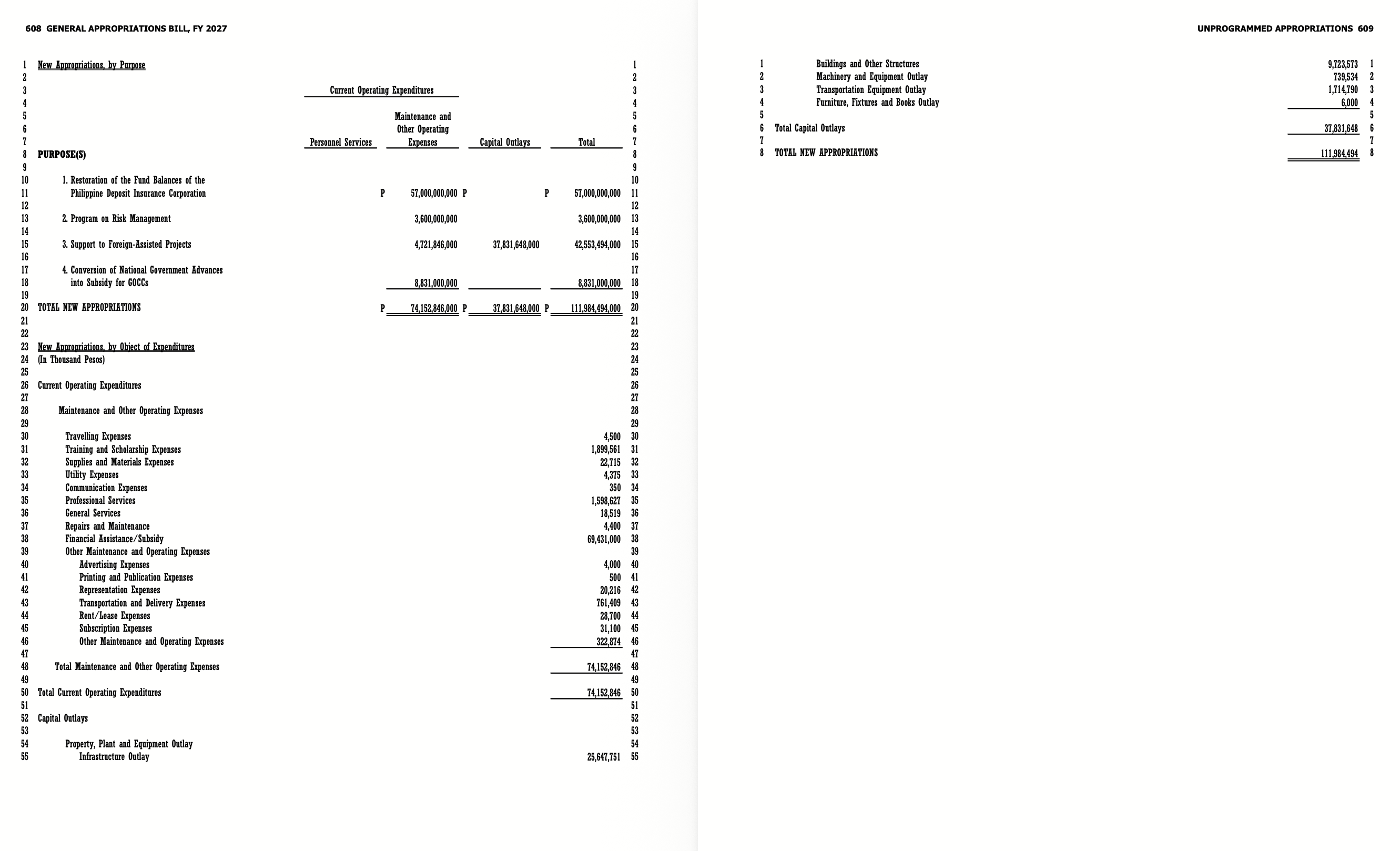
The House bill's Unprogrammed Appropriations (pages 607–609) match the NEP (Volume III, pages 961–967) in amount, purposes and every special provision. [5][6]
| Purpose | NEP 2027 | House bill 2027 |
|---|---|---|
| Restoration of the Fund Balances of the PDIC | 57.00B | 57.00B |
| Program on Risk Management | 3.60B | 3.60B |
| Support to Foreign-Assisted Projects | 42.55B | 42.55B |
| Conversion of NG Advances into Subsidy for GOCCs | 8.83B | 8.83B |
| Total | 111.98B | 111.98B |
The ₱42.55B is ₱4.72B in operating expenses and ₱37.83B in capital outlay, of which ₱25.65B is infrastructure outlay. [5][6]
What the text means:
- No offset was added. There is no increase and no GOP-counterpart purpose, so at least ₱27.2B of counterpart cuts (DPWH ₱19.5B, DOTr ₱7.7B) has no route back through Unprogrammed Appropriations.
- But nothing stops the ₱42.55B from funding the projects the House cut.
- No projects are named.
- Release needs only a perfected loan agreement.
- The purpose is ranked "not requiring excess/new revenue collections."
- Nothing excludes items cut from the programmed budget.
- The limits are size (₱42.55B against at least ₱94B of cut loan proceeds) and displacement: any cut project funded this way pushes out whatever the pool was sized for.
- The 2024 priority text is now in the Executive's own NEP.
- No ban on infrastructure appears in these pages. The Daily Tribune reported that the House kept a 2026 rule barring Unprogrammed Appropriations from infrastructure. That rule is not among these special provisions, and the pool carries infrastructure outlay. Check the bill's General Provisions before citing the rule either way. [11]
5. What this means for borrowing
- No new loan agreements are needed. The cut projects' loans are already signed, and the 2024 and 2027 texts accept them as the funding condition.
- More borrowing than the program shows. If cut FAPs are released from Unprogrammed Appropriations, their loans are drawn outside the deficit ceiling. Meanwhile the insertions that took their place inside the ceiling still have to be financed. The actual deficit exceeds the programmed one by roughly the amount released.
- If the projects are not released, the cost moves elsewhere:
- More expensive financing. General borrowing (mostly domestic bonds) replaces concessional project-loan drawdowns.
- Delayed projects with rising costs: undrawn loans, possible commitment fees and extensions of closing dates, price escalation, and contractor claims.
- The "absorptive capacity" defense works against itself. If the cut amounts could not have been spent in 2027, moving the authority to insertions that do get spent raises actual spending and borrowing above what would otherwise have happened.
5a. Does it raise the deficit?
In most cases, yes. In none does it lower the deficit. The deficit is cash spending minus revenue. It doesn't matter which pot an item was appropriated from, or whether it is paid with loan money: if it is spent, it counts. Moving items between the programmed budget and Unprogrammed Appropriations changes how the budget looks on paper. What changes the deficit is how much more gets spent.
Outcome 1: the cut projects are funded from Unprogrammed Appropriations. The deficit rises.
- Inside the ceiling, the insertions take the projects' place and get spent.
- Outside the ceiling, the projects are released on their existing loans and get spent too.
- Loan-backed releases need no excess revenue, so nothing on the revenue side offsets them.
- The actual deficit ends up above the programmed one by roughly the amount released and spent. The 2024 text allows this, and the 2025 releases show it happening: ₱120.81B to FAPs, including ₱40.53B back to DOTr. [2][5]
Outcome 2: the cut projects are not funded. The effect depends on whether they could have spent the money.
- On paper, there is no change: total spending stays at the NEP level.
- If the projects could have spent it, the deficit is about the same. Insertions are spent instead of the projects, and the cost appears as delays, project-cost overruns, and more expensive borrowing in place of concessional loans.
- If the projects could not have spent it (the "absorptive capacity" justification), the deficit rises. Money that would have gone unspent becomes insertions that do get spent. The truer the justification, the larger the increase.
Outcome 3: releases are funded by excess revenue. The deficit does not fall as it otherwise would. Spending a revenue windfall keeps the deficit at the program level. Without that spending, the windfall would have lowered it.
The GOCC fund sweep defers the cost. Under 2024's condition (d), GOCC fund balances were remitted to the Treasury. That counts as National Government revenue, so it made the 2024 deficit look smaller. The 2027 NEP now proposes ₱57B to restore part of the PDIC's remitted balances: spending in a later year. [2][5]
| Outcome | Deficit against the program | Deficit against no cut |
|---|---|---|
| Cut projects funded from Unprogrammed Appropriations | higher | higher |
| Not funded; projects could have spent it | about the same | about the same; the cost shows up as delays and more expensive borrowing |
| Not funded; projects could not have spent it | about the same | higher |
To put a number on it: set the budget department's quarterly reports on releases from Unprogrammed Appropriations against the Bureau of the Treasury's cash operations reports. That gives the actual deficit against the programmed deficit in the Budget of Expenditures and Sources of Financing (BESF), for 2024 and 2025. The DBCC plenary workbook gives only one deficit figure per year, so it cannot make this comparison.
6. Still to check
- The President's 2024 veto message (GAA Volume I-B, page 784): the conditions attached to Special Provision 5.
- The budget department's quarterly reports on releases from Unprogrammed Appropriations, 2024 and 2025, required by the special provisions: releases by project, loan against counterpart.
- The actual deficit against the programmed deficit, 2024 and 2025: Bureau of the Treasury cash operations reports against the BESF program (see section 5a).
- The other agencies' FAP cuts in 2024 (DPWH, DA, DOH and others). This folder has only DOTr.
- At which stage Unprogrammed Appropriations rose in 2024 and 2025: the House, the Senate or the bicameral conference.
- Whether 2026 FAP appropriations remain available in 2027 under the 2026 GAA's general provision on validity of appropriations. If so, they would soften the 2027 cuts.
- The Senate version and the bicameral report for 2027. Watch for an increase in the ₱42.55B, a new counterpart purpose, a named list of projects, or a new release condition.
Sources
- [1] FY 2024 NEP, Volume III, Unprogrammed Appropriations, pp. 1024–1031.
- [2] FY 2024 GAA (R.A. No. 11975), Official Gazette Vol. 119 No. 52 (25 December 2023), Unprogrammed Appropriations, pp. 737–744: Special Provision No. 1 (p. 737), Special Provision No. 5 and the veto annotation (p. 738), Purposes 3, 9 and 17 (p. 740). The PDF's text layer is unreliable; the figures were read from page images.
- [3] FY 2024 NEP, Volume III, Department of Transportation, foreign-assisted projects, pp. 323–326.
- [4] FY 2024 GAA, Department of Transportation, foreign-assisted projects, p. 369.
- [5] FY 2027 NEP, Volume III, Unprogrammed Appropriations, pp. 961–967, including the 2025 release table. From dbm.gov.ph/wp-content/uploads/NEP2027/UA.pdf
- [6] HB 10858, FY 2027 GAB, Unprogrammed Appropriations, pp. 607–609. page 607 (image), pages 608–609 (image)
- [7] BARSC 2027 reconciliation with the House bill: FAP subtotals by agency, NEP against HB 10858, with page references.
- [8] DPWH FY2027: NEP vs House GAB: DPWH FAPs project by project, loan against GOP counterpart, and the program-group changes.
- [9] The Funds Congress Cuts, from the office’s “Padding DOTr and DPWH foreign assisted” workbook and the DBCC plenary workbook: DOTr FAPs, NEP against GAA, 2016–2026, and the MPBF and Pension and Gratuity Fund cuts.
- [10] GMA News, "House approves P7.2 trillion 2027 budget on final reading" (12 October 2026): gmanetwork.com
- [11] Daily Tribune, "House vows safeguards on P112B unprogrammed funds in 2027 budget" (11 August 2026): tribune.net.ph